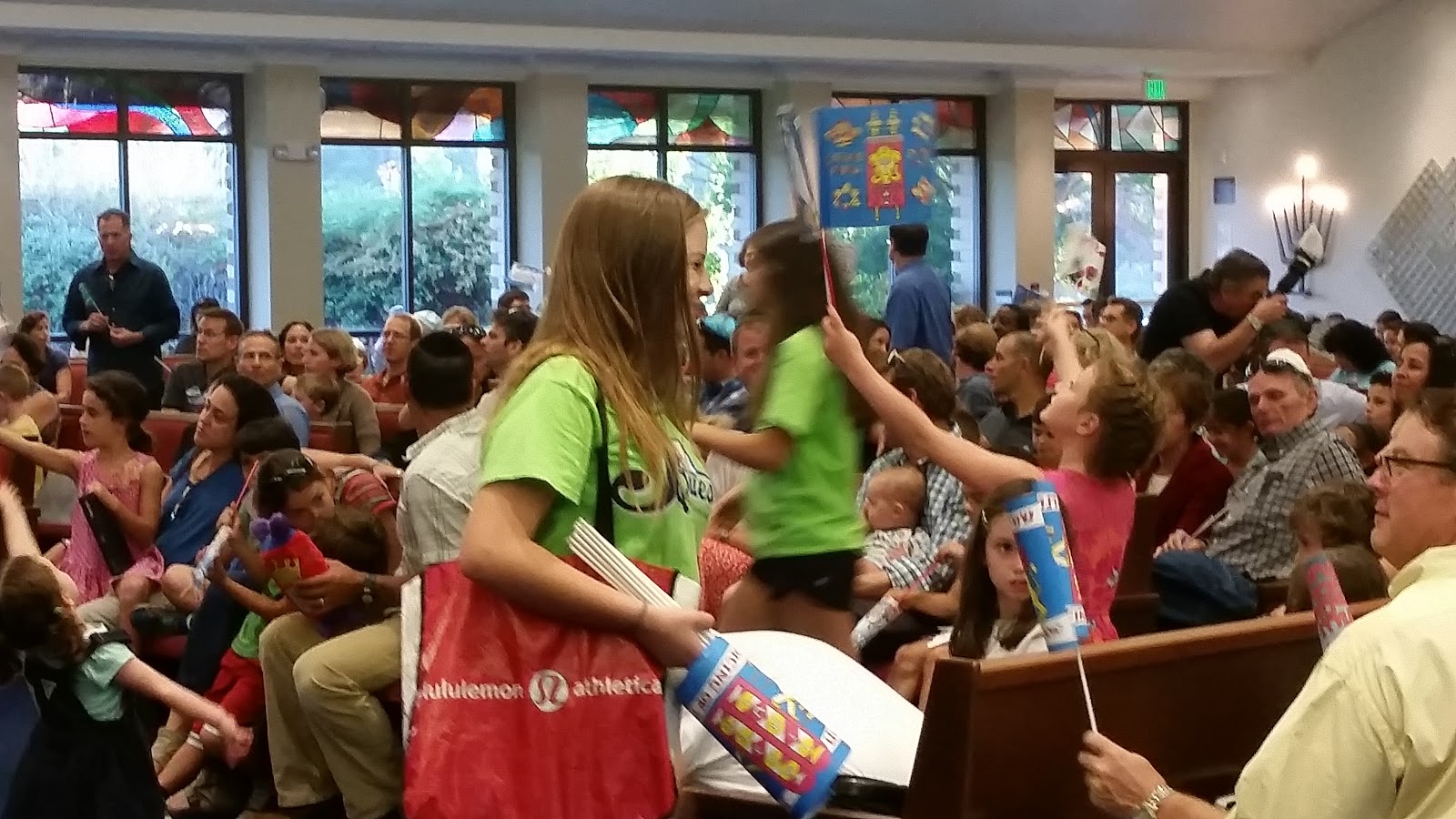
Today, our class met in the afternoon, in order to celebrate Simcha Torah with the rest of the congregation this evening. It was a joyous gathering, with much singing, dancing and laughter.
We unrolled the Torahs, holding them up as we sang "Romemu."
Shiraniks holding the Torah!
ca
Cantor Korn leading the congregation in reciting the blessing over the Torah.
Rabbi Graetz showing us the first and last portions in the Torah.
Everyone got in on the act!
The Israelites cross the Reed Sea! See how it looks like water?
A Kleztones-eye-view of the congregation!
It was a packed synagogue as we all came to celebrate the giving of the Torah!
Leah helps pass out Simcha Torah flags.
Look at all those future Shiraniks getting a blessing from Cantor Korn and the rabbis!
Ethan and the Kleztones rocked the house!
Torah holding teachers!
And now we dance! Doing hakafot as we danced the hora with the Torah!
Simcha!
Maimone: You wanna dance with the Torah? You talkin to me?
Welcome to Shira 2015-16!
This year is already turning into an awesome year in Shira, and I am very much enjoying working with the Shira class of 2015-16! Since the year got off to a bang with the High Holy Days, Sukkot, and Simcha Torah, I'm putting all of our wonderful experiences from our first two weeks into this, the first blog of the year.
We began by getting to know each other, and creating a class "symphony quilt." What is a "symphony quilt," you ask? Well, each of us has a unique "note" that we can play that is part of a larger symphony. We all bring something different to the table, and as the year goes on in Shira, we will work together in harmony. I asked the students to think about, and write their own "note." This includes: Nature - what is your nature, or personality? Ovation - what accomplishments are you proud of? What would get you a standing ovation? Talent - what are you talented at? Expression - how do you express your Jewishness?
The Shiraniks created some very nice quilt pieces, and shared their own Notes with the rest of the class. After sharing, we were inspired to schedule a class talent show (we have some awesome talents in Shira!) - date TBA!
On Tuesday and Wednesday, we welcomed our new songleader, Maya, to class, and had a wonderful kumsitz with her during our first weekday session. The Shiraniks shared their favorite musical artists or groups, and we sang, we shmoozed and we kibbutzed!
We also began a new tradition for 5th and 6th grade - a community building gathering at the beginning of each weekday session, in which we spend the first ten minutes of class together with Y'itzirah and Edot. As a large group, we settle in, play a game related to some Jewish concept or value, and get into the JQuest spirit before breaking into our individual classes. This week, we played Jewish Rituals Charades.
I told the students that Sukkot is my favorite holiday of all, and when they asked why (after giving me a funny look when I said it's even better than Hanukkah), I told them it's because during Sukkot we are commanded to BE HAPPY!!! Yep, it's a mitzvah. We are supposed to be happy, celebrate and have lots of fun for seven whole days! What a great holiday, right?
We joined Charna's class in the Sukkah
Erin asks, "What is a sukkah?"
On Wednesday, it was too wet to go into the sukkah, so we had our Sukkot lesson in the BK!
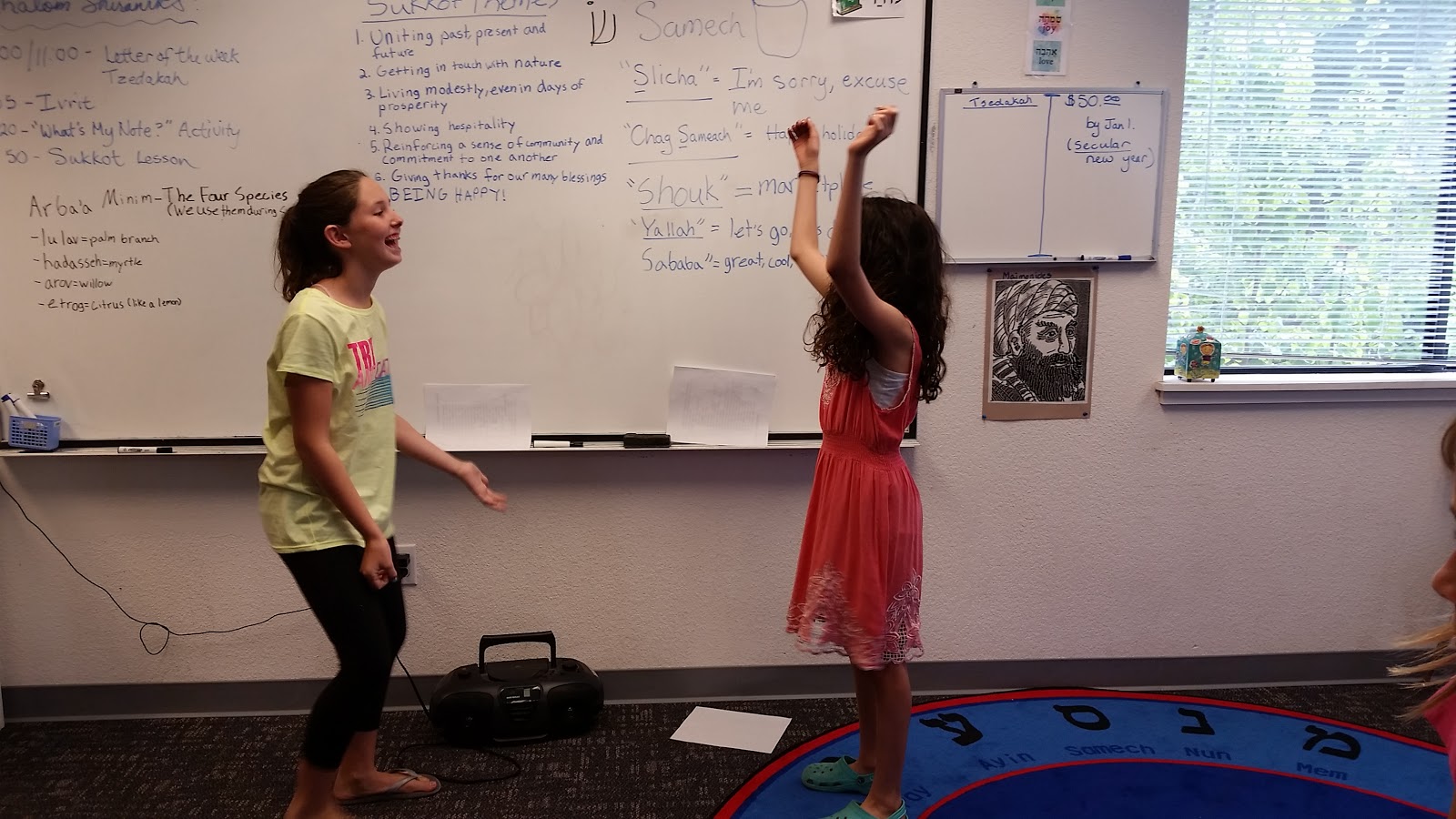
Tammy and Yardena taught the Shiraniks some new sukkot words, like "simcha" (happiness) and "sukkah" (booth)
We acted out ways in which we can fulfill the commandments of Sukkot.
Celebrate!
(Not quite sure what the Avodahniks were going for here...but it must have been a mitzvah!)
How Do We Celebrate Sukkot?
During our second Sunday, and first weekday classes, we learned ways in which we celebrate Sukkot. Some of the main points about the holiday of Sukkot include:
What does “sukkot” mean?It means “booths” (plural of "sukkah")
What is a “booth”? A temporary shelter.
When did the Israelites have to live in temporary shelters? During the 40 years of wandering after the Exodus from Egypt
What do we do during Sukkot? During Sukkot, we build a sukkah. We eat, play and even sleep in the sukkah. We decorate the sukkah with natural and man-made decorations.
What else do we call Sukkot?
The Feast of Tabernacles
The Feast of Ingathering…
Why is it called the “Feast of Ingathering?” Here's a hint: If you lived on a farm, what would you be doing now? Picking your fruits and veggies, of course! You would be "gathering in" the harvest to get ready for the winter.
How is Sukkot similar to Thanksgiving? It is a time to give thanks for what we have, family gathering, celebration, food.
How is it different?
We build a sukkah, eat and sleep outside, say Hebrew blessings, shake the lulav, and invite the Ushpizin to join us in the sukkah.
What are “Ushpizin?” Ushpizin are guests. During Sukkot we invite the seven patriarchs of Israel -- Abraham, Isaac, Jacob, Moses, Aaron, Joseph, and King David to join us in the Sukkah, as well as the Imahot - the "mothers" - Sarah, Rebeccah, Rachel and Leah, . We also invite others to join us, including friends, family, and even strangers. It is a tradition to include a special place at our table for family and friends who have passed away, but that we want to “invite” to the party, remembering them during this holiday. (We had a very interesting discussion about how Sukkot was similar to the Mexican celebration of the Day of the Dead, in which family members are remembered at a festive family picnic each year.)
Why do we shake the lulav? And what the heck is a lulav, anyway?! It is a special mitzvah to have and use the Four Species (Arba'a Minim) during Sukkot. These are Myrtle (Hadar), Palm (lulav), Willow (Hadasseh) and Citron (Etrog).
It is a positive commandment from the Torah [Leviticus 23:40] to gather together the Four Species during Sukkot:
“On the first day you shall take the product of hadar trees, branches of palm trees, boughs of leafy trees, and willows of the brook, and you shall rejoice before Adonai your God seven days.”
We learned the blessing over the shaking of the lulav, which begins like other familiar blessings, and ends with "al netilat lulav."
Baruch atah Adonai eloheinu melech a olam asher kidshanu b'mitzvotav vitzivanu al netilat lulav.
Then, the students learned the process of shaking the lulav (which we do daily, in the sukkah, preferably in the morning) by singing a silly song that I wrote called The Lulav Shake.
In recent weeks, the students have been enjoying the silliness of Purim
and the joyful month of Adar. Now we are switching our class "nusach,"
or tune, to get ready for Passover. Out with the mishigas, and in with
the matzah! To mark the end of Adar, we finished recording our silly
story about Louis Lewandowski today, and we will be editing and posting
the final product soon. (Look for trailers in a theater near you!)
The unedited last scene of our video!
The students also had a special visit by former Shira instructor Rachel Mylan, who taught us a new version of Avadim Hayinu!
In tefillah last week, Rabbi Miller showed the sixth graders what the week's Torah portion looks like - Mi Chamocha is shaped like the sea! In class, we had done shape poems earlier in the year, and the students realized just how beautifully poetic the Torah can be!
The Torah looks like mayim!(water)
Last weekend, some of our fifth grade families attended a wonderful field trip to the Contemporary Jewish Museum in San Francisco. They completed their own works of art, learned about the Ashkenazi Jews of Poland and Russia, and enjoyed listening to the sounds of the Hardly Strictly Bluegrass festival sponsored by philanthropist Warren Hellman.
Well, as a new Hebrew month begins, our little Shira group is happily creating a (slightly silly) video about the life of one of the Reform movement's premier composers, Louis Lewandowski. We have been having fun telling the tale of this innovative Jewish maverick from 19th century Germany.
Mr. Lewandowski introduced the Jews of Germany to a new, more classical form of liturgical music. Thanks to Louis Lewandowski and his contemporary, Salomon Sulzer, we have the option to enjoy liturgical music sung by a choir and accompanied by instruments such as an organ or piano. Major changes brought about by the Reformers in Germany in the 19th century include:
a greater sense of decorum
services conducted in the native tongue of the congregants
a move away from the Oriental (Middle Eastern sounding) style of chanting and towards a more Western (European/"classical" sounding) style
The removal of separation of men and women in synagogue
choral music
organ music
a move to be less "different" than their Christian neighbors; assimilation
Here is a sample of Louis Lewandowski's liturgical music, performed recently in the Berlin synagogue in which he worked for over 25 years:
Note the German, rather than Hebrew service!
The students have enjoyed making their own music, learning to sing the Four Questions, and some new Passover song. They have been identifying the Hebrew words that they already know in the new songs. Words like shir (sing), simcha (joy), aviv (spring), gadol (great, or big), ma (what), and laila (night) can be found in the Four Questions and other Passover tunes.
Wednesday, March 11, 2015
Thank you to all the parents who attended the first ever Shira Family Day in February! We had fun showing off what Shira has been up to, and learning new dances (how fast can YOU dance the hora now?). This month, we have been learning about the Haskalah (Jewish Enlightenment) and the early Reform movement in Germany. To wrap up the unit, the students are recording a video about the life of Louis Lewandowski, who contributed a great deal to moving the Jewish liturgy into the modern era. Thanks to Lewandowski and his peers, such as Solomon Sulzer, we now enjoy music as part of our liturgy.
Don't forget that this Sunday, we will be having a special field trip to the Contemporary Jewish Museum for all 5th grade families - 2nd Session only!
For our spring "5th Grade B'nai Mitzvah Prep" session, we invite you to a
family field
trip to visit the Contemporary Jewish Museum! All Temple Isaiah
students receive a gift of free membership to the CJM when they become
bar/bat mitzvah, so we wanted to give them an opportunity to visit the
museum and see what it's all about. This will be a wonderful off-site
gathering of all the Temple Isaiah 5th grade families, and we hope you
can attend!
We will have a special
tour focusing on the exhibit "Letters to Afar," about the thriving Jewish life in Poland during the 1920's and 1930's, followed by an art project related to the exhibit. This is a wonderful wrap up for the students, as they finish their studies about the Ashkenazi Jews, and move into modern Jewish America and Israel.
All
5th graders are required to attend with a parent, grandparent, or other
adult. Siblings are welcome, too. Please
indicate how many from your family will be able to attend. There is no
charge for this event, as it is sponsored by Temple Isaiah.
We will gather at 9:45am at the front entrance of the CJM. The museum is easily accessible by BART or car.
If
you have any questions, please contact Charna at charnas@temple-isaiah.org. We are excited about this field
trip and hope you can all make it!
Here are a few photos from our Purim Carnival this year:
Shalom Shiraniks!
First, let me welcome you all back, and remind you to mark your calendars for our Shira Family Day on Sunday, February 8th during first session. All students and their families are invited to join us for a fun, musical and educational session that day. (There will be no second session on Feb. 8th) More details coming shortly...
This week, we are focusing on the great changes in the Western European Jewish community in the late 1700's and early 1800's. As a result of political and industrial revolution, widespread social change offered new opportunities for European Jews. Enlightenment ideas provided more freedoms for Jews who were once confined to ghettos and forced to endure legal restrictions that limited their opportunities for social and economic growth. Additionally, the industrial revolution created a new middle class, and the literate Jews began to rise to positions of status as merchants, manufacturers of textiles and as professionals. As a result, families such as the Rothschilds were able to achieve great financial and social success. The Haskalah, or Jewish enlightenment ensued, and the Reform movement was born out of many Jews' frustration with "old fashioned" Jewish traditions that they perceived as barriers to social inclusion into European society.
Here is link to the PBS documentary, "Roads from the Ghetto," an excerpt from the Heritage Civilization series that we are using as a class resource. https://www.youtube.com/watch?v=fbU-9pN86bc
We focused on the first 12 minutes in class, however the entire program is quite interesting, and I encourage you to watch it all if you are able.
Shavua tov!
Shalom Shiraniks!
May you all be enjoying the love and light of Hanukkah with your friends and family. (And enjoying your musical menorahs, which by the way, you should take care not to let the candles burn too low in, as they are really more for show, since they are wooden!)
Here are a few shots of the kids' last week before break (a.k.a. "Bring A Friend" Week). Chag Sameach Chanukah! See you in 2015!